top of page
FUTURE
GREENS
TURN ORGANIC WASTE INTO GREEN POWER ONSITE

A quarter of global gas demand could be met with biogas
from organic waste. We're on a mission to unlock this potential.
We build advanced anaerobic digesters
that make organic waste-to-energy
systems cheaper and easier to deploy.
.png)
85% smaller
Our high-rate reactor needs a fraction of the space, which makes it cheaper to build and easier to fit on industrial sites.
_edited_edited_e.png)
Liquids & solids
We handle all organic waste streams in one compact reactor for simpler deployment and maximum energy recovery.
_edited_edited_e.png)
Autonomous
Our AI-native control and advanced sensing enable remote monitoring and
low-touch operation.
Our first system is for breweries.
It tackles energy, water and carbon emissions
with one compact reactor.
HOW IT WORKS:
All organic co-products and wastewater go into an on-site bioreactor.
Inside it they get consumed by anaerobic bacteria that release biogas.

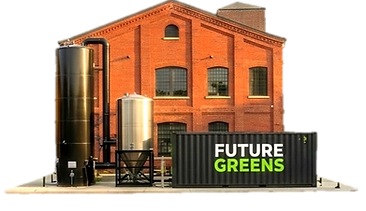
Small system, big impact:
Continuous energy for 25-50% of brewery demand.
Clean wastewater
and save 60% on trade effluent bills.
Reduce Scope 1 emissions with renewable gas.
For breweries of all sizes:
Our smaller, modular design makes anaerobic digestion accessible and affordable. Offered to first customers at no upfront cost.
SMEs
Our reactors generate 7 times more power from the same volume than the industry standard. This unlocks a faster payback and a system that uses less space.
Corporates
Our Team
We built our first anaerobic digester to solve energy and waste problems for our own food manufacturing operation.
Today, we leverage this first-hand experience and our backgrounds in engineering, automation, AI, and finance to develop a new generation of organic waste to energy infrastructure for the food industry and beyond.
_edited.jpg)


Our first digester
In 2024 we built a 25,000l reactor and ran it with waste from The Brewery of Saint Mars of the Desert.
Despite its high quality gas, the system was too large and it inspired us to develop our novel method to reduce reactor footprint.

Proudly backed by:



bottom of page